
The first call sounds excellent. The voice is clear, the greeting is warm, and the appointment is booked in under a minute.
Then someone asks to move the appointment, corrects their surname, and mentions that the address on file is wrong. This is where a useful evaluation begins.
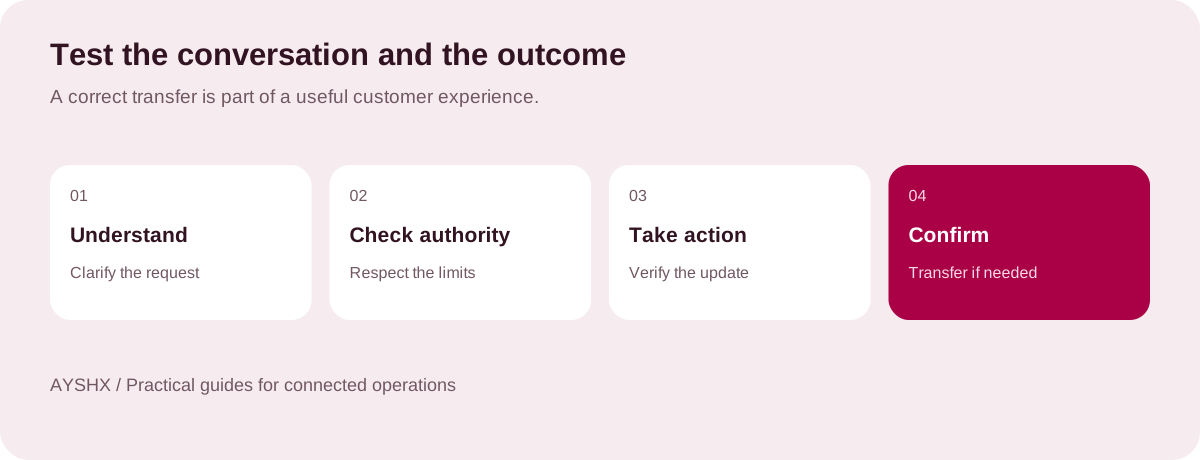
Evaluate an AI voice agent by whether it completes the right task, handles uncertainty, and transfers context when a person needs to step in. A convincing voice matters, but the conversation and the underlying business action need to work together.
Decide which job the voice agent is being hired to do
“Answer customer calls” is too broad for a first deployment. An order-status enquiry, an appointment change, and a disputed payment need different information, permissions, and escalation paths.
Choose a bounded use case. For example, the agent may identify a caller, retrieve an eligible appointment, offer available times, and confirm a change. Write down where that authority ends. It might need a person to handle a cancellation fee or a complaint.
Also confirm the type of system being demonstrated. A dialer initiates or manages calls. An IVR routes callers through predefined choices. An AI voice agent can interpret conversation and may be connected to tools that carry out tasks. Agent assistance helps a human representative during the call. Products may combine these capabilities, but they are not interchangeable.
Build a test set from ordinary customer behaviour
A script that everyone reads perfectly will tell you very little. Collect representative call scenarios, remove personal information where appropriate, and include the variations your team encounters.
A caller may not know an order number. Someone may interrupt the greeting. A customer may describe two issues in one sentence, change their mind, or say “next Friday” while travelling in a different time zone.
Test straightforward cases alongside difficult ones, and record results by category. The purpose is to learn where the system works and where it needs a different design. Keep some scenarios out of the tuning process so the final check includes unfamiliar examples.
Listen for understanding, timing, and recovery
Listen on the channel customers will use. Telephone audio can behave differently from a clean browser demonstration. Microsoft’s speech documentation, for example, describes specific audio optimisation for narrowband telephone scenarios. That is a useful reminder to test the actual call experience. See Microsoft’s voice and audio documentation.
During each call, check whether the agent:
- Lets the caller interrupt without losing the request.
- Responds promptly enough for a comfortable conversation.
- Recognises corrections to names, dates, addresses, and amounts.
- Asks a focused question when the request is ambiguous.
- Recovers after silence or a misunderstanding.
- Avoids repeating an answer that has already failed to help.
Pay particular attention to confirmation. Reading back a date or amount gives the caller a chance to catch an error. Repeating every word makes the experience exhausting. Decide which details are important enough to verify explicitly.
Treat multilingual support as a separate evaluation
A list of supported languages is a starting point. Your customers may use regional accents, switch languages during a sentence, or pronounce a product name differently from the rest of the conversation.
Use fluent reviewers for each language that matters to the deployment. Ask them to evaluate comprehension and task completion as well as pronunciation. A pleasant accent does not establish that the agent understood a cancellation request.
Include names, locations, numbers, and industry terminology. Test whether a caller can ask a question in one language and receive an appropriate response in another. Confirm that the written summary preserves the meaning for the team receiving it.
Record results separately by language and scenario. A strong overall score can conceal a poor experience for a smaller customer group. Avoid assuming that success in one language transfers to another.
Check the business action after the call
If an agent says an appointment has changed, inspect the booking system. If it promises a callback, check whether the task exists, has an owner, and contains the correct details.
Test a failed integration deliberately. Temporarily unavailable software, a missing customer record, or a rejected update should produce a sensible response. The agent should not claim success merely because it generated a confident sentence.
Also check repeated requests. If a customer asks twice whether a change went through, the system should not create two bookings. Ask how the implementation prevents duplicate actions and reconciles uncertain results.
Make the human handoff part of the demonstration
Ask to speak to a person early in a call, halfway through a task, and after the agent has misunderstood something. Inspect what the receiving representative sees.
A useful transfer includes the caller’s request, relevant verified details, actions already attempted, and the reason for escalation. The representative should be able to distinguish confirmed information from the agent’s interpretation.
Then test the less convenient situation: nobody is available. There should be an agreed fallback, such as a callback request with an accurate expectation. Do not leave the caller cycling through the same conversation.
Use a scorecard with clear pass conditions
| Area | Evidence to collect |
|---|---|
| Task completion | The intended outcome verified in the business system. |
| Information accuracy | Correct names, dates, amounts, and policy answers. |
| Conversation quality | Reviewer notes on interruptions, delays, and recovery. |
| Escalation | Successful transfer or fallback with usable context. |
| Language performance | Separate results from fluent reviewers. |
| Cost | Total evaluated cost per successfully completed task. |
Set the pass conditions before testing. Some errors should block a rollout even if the average score looks good, such as confirming an action that never happened or disclosing another customer’s information.
Count transfers honestly. A necessary transfer can be the correct outcome, but report it separately from a task completed by the agent. Keep enough detail to understand whether transfers reflect good judgement or a recurring failure.
Compare complete costs
Request a quote that separates platform charges, call usage, telephony, setup, integrations, support, and any additional voice features. Check what happens when usage exceeds the plan.
Include internal review time. An agent that needs substantial monitoring may still be useful, but that work belongs in the business case. Long calls, repeated attempts, and abandoned conversations also affect the economics.
Cost per successful task = total relevant operating cost ÷ successfully completed tasks. Use the same definition of success for every option you compare, and keep escalated outcomes visible.
Start with a limited live rollout
Once the test conditions are met, introduce the agent to a controlled share of suitable calls. Review failures, monitor customer feedback, and keep a quick route back to the previous process. Recheck performance when languages, scripts, tools, or policies change.
Let callers know when they are interacting with an automated system. Agree on data handling, recording practices, and permitted actions for the intended markets before launch. If a custom voice is involved, confirm the rights and consent for that voice.
AYSHX’s Rovoca Voice AI is a starting point for discussing multilingual calling workflows. Bring your difficult call scenarios to the evaluation conversation. They will make the demonstration much more useful.